
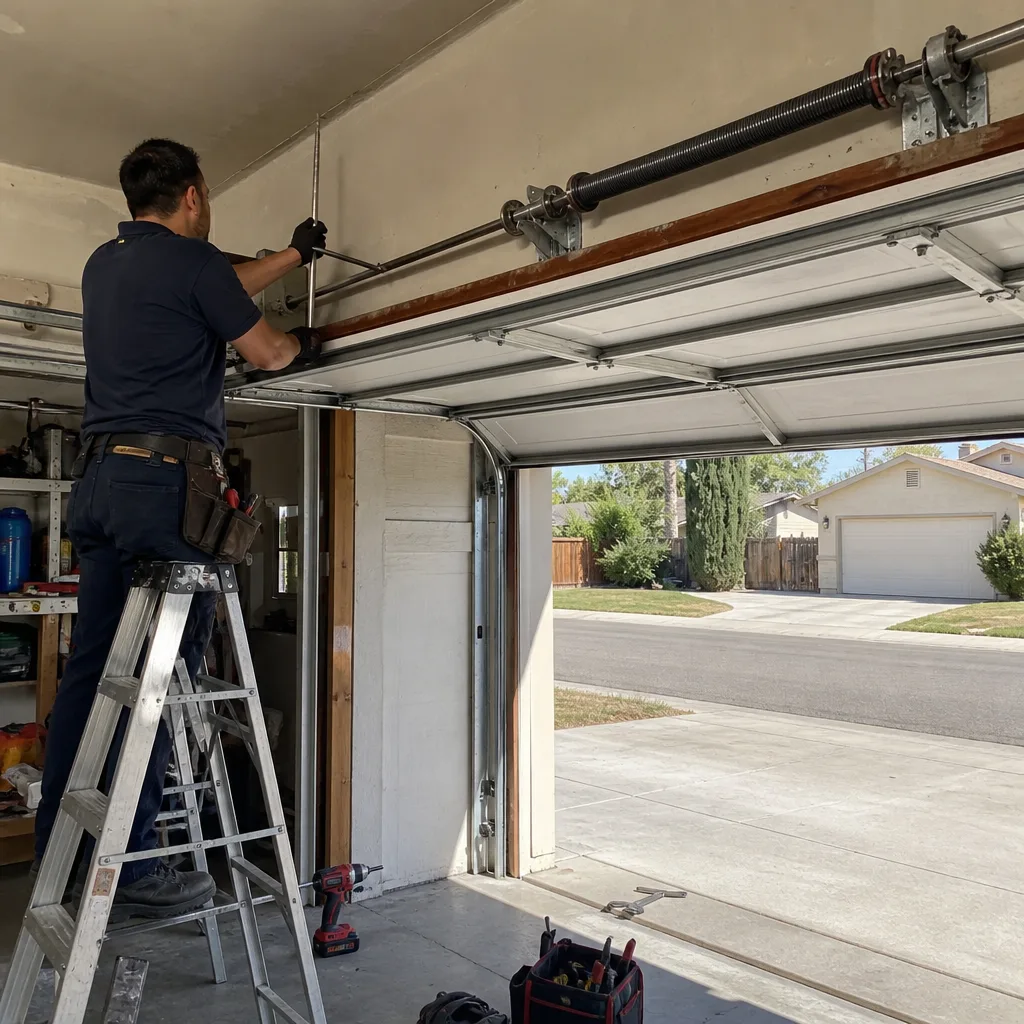
Last updated November 3, 2026
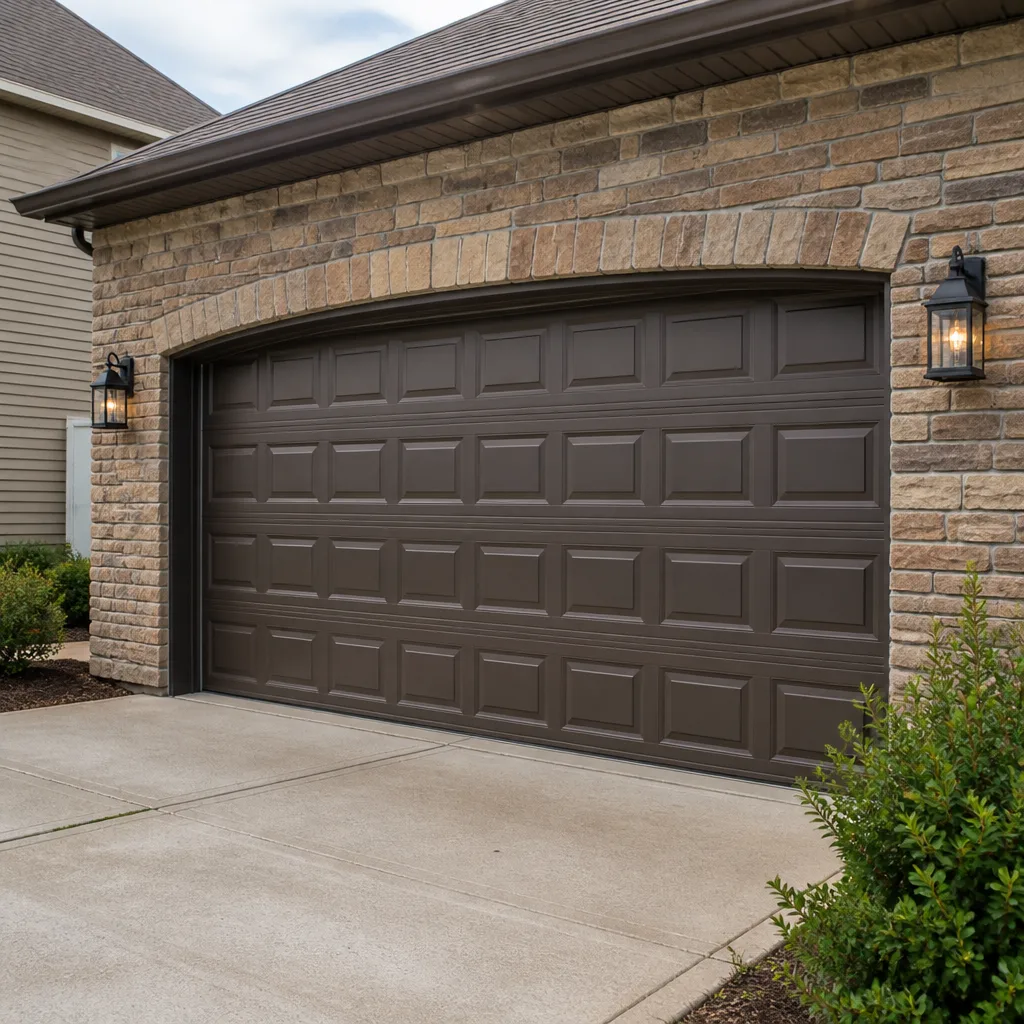 Raised-panel steel
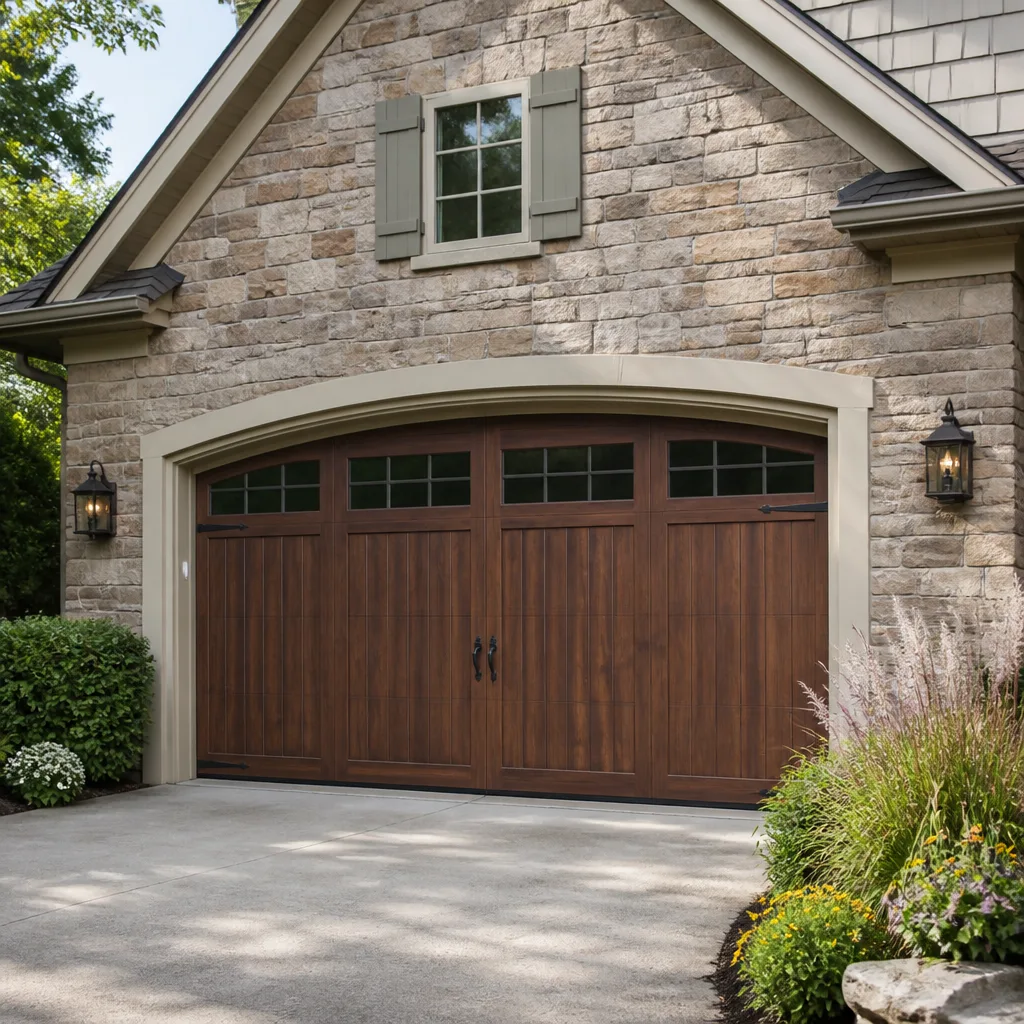 Carriage house
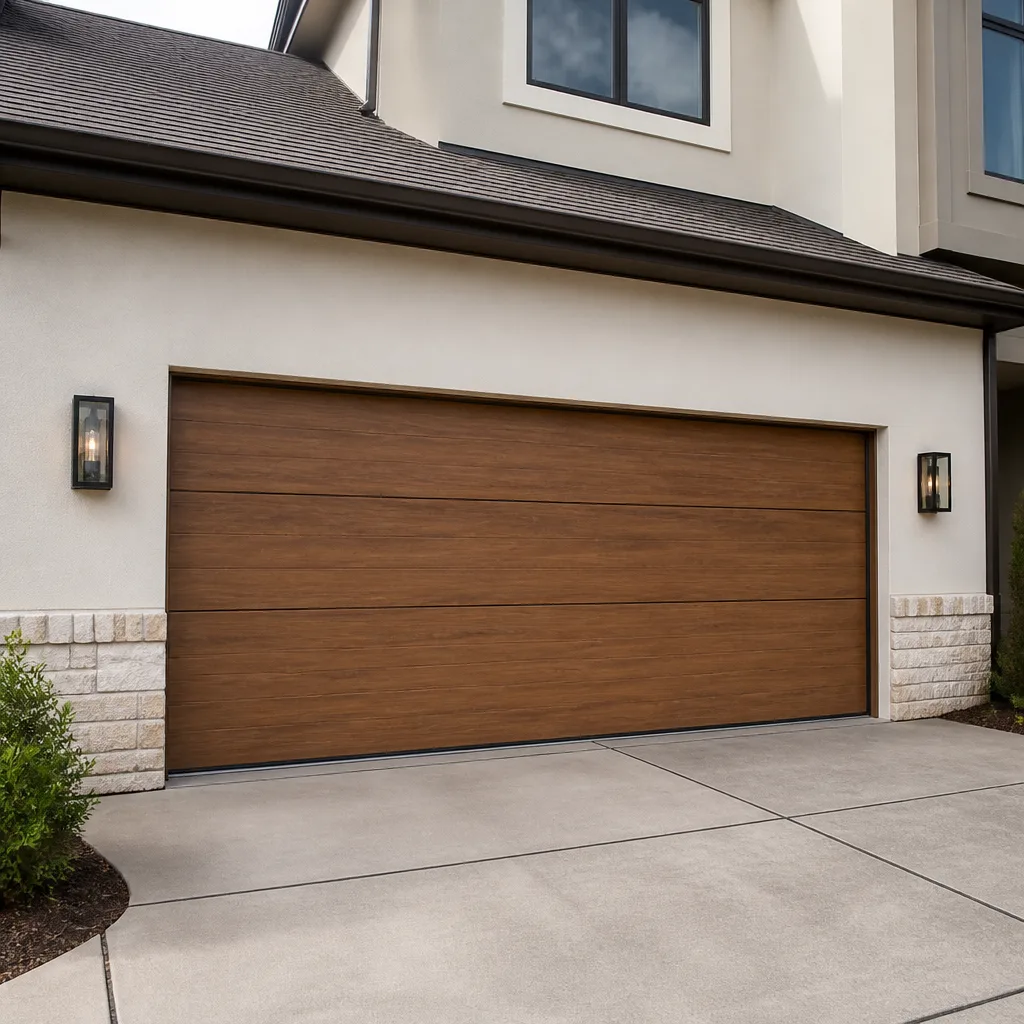 Modern flush
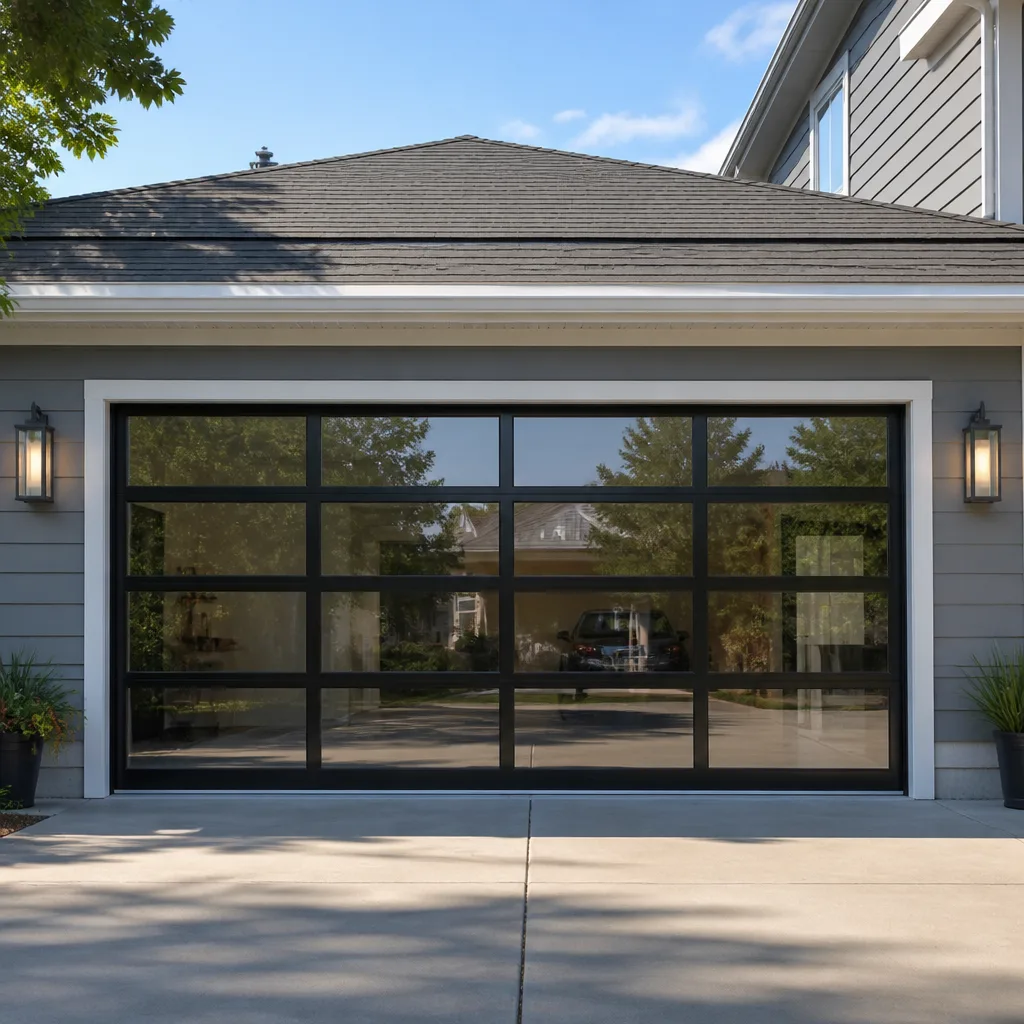 Full-view glass
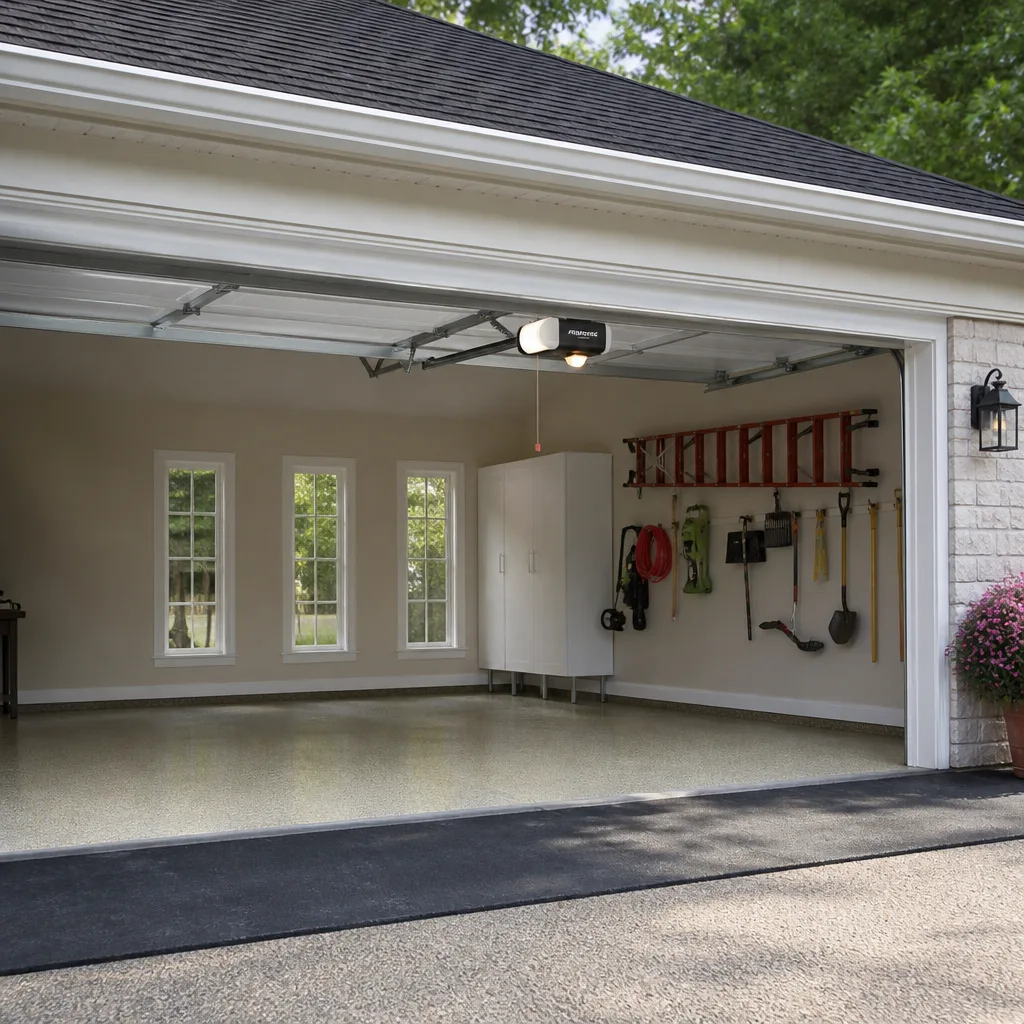 LiftMaster openers
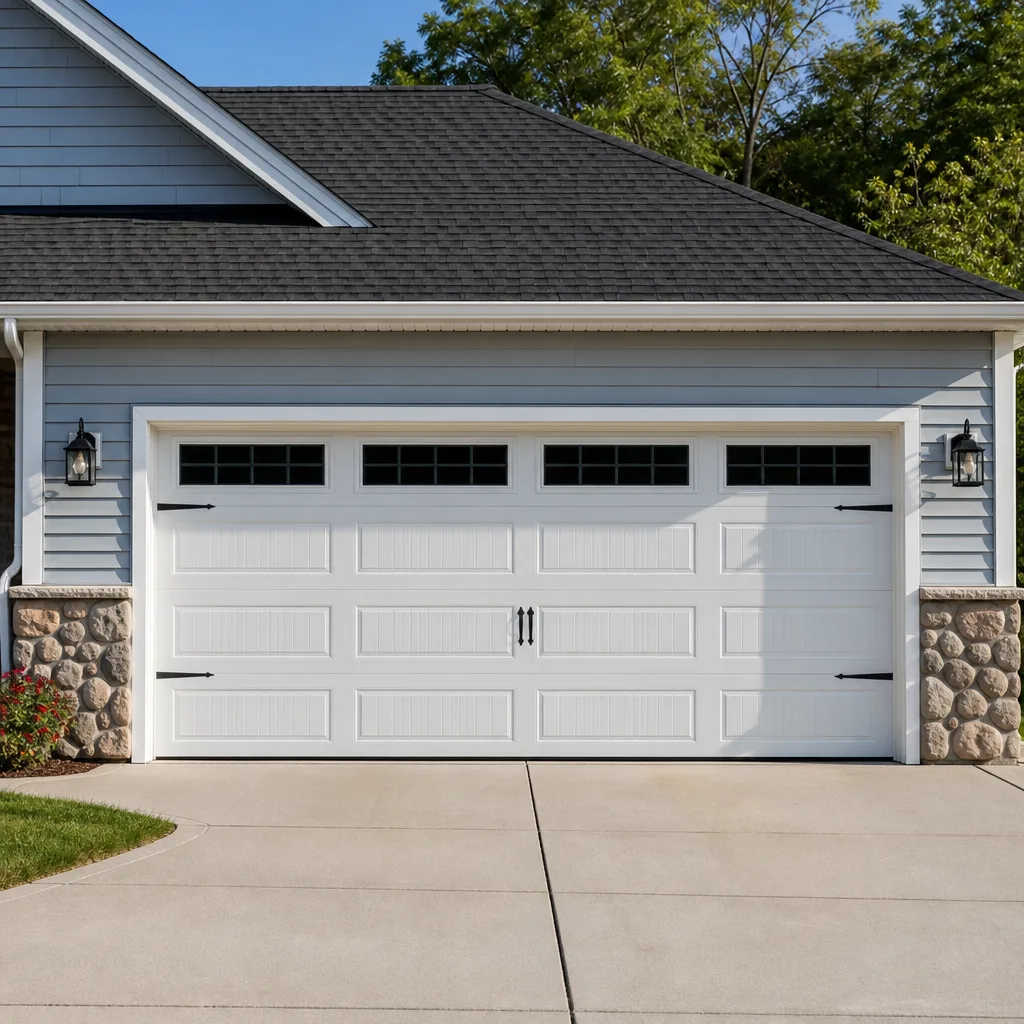 Chamberlain openers
Full 25-point door and opener safety check with every visit - springs, cables, rollers, tracks, and your LiftMaster or Chamberlain opener included
You get a price before we start. It does not change when the truck arrives.
Get your free estimateThe Complete Garage Door Repair Guide for Hemet Homeowners
Hemet’s Inland Empire heat regularly pushes garage interiors past 130°F in summer, a detail almost every national repair guide ignores. Yet it’s the single biggest driver of premature spring fatigue and cable fraying on local doors. This guide gives you a climate-aware diagnostic framework built for the San Jacinto Valley, not a generic checklist recycled from a Minnesota contractor’s blog. You’ll learn which repairs you can handle safely and which ones demand a specialist, as covered in our Garage Door Repair services, plus how to sequence problems so you stop chasing symptoms and fix the root cause.
Quick Answer
Most garage door failures in Hemet trace back to three root causes: heat stress on torsion springs, dust intrusion in rollers and tracks, and deferred lubrication on moving parts. Knowing which one you’re dealing with determines whether you’re looking at a $15 fix or a $400 service call. Start with the door’s balance test, then work through springs, cables, rollers, tracks, and finally the opener, in that order. If a torsion spring has snapped, stop and call a professional: the stored tension in those springs is measured in hundreds of foot-pounds, not casual force. For context on when to DIY versus calling in help, see our DIY vs Professional Garage Door: The Hemet Homeowner’s Decision Guide.
Hemet-specific reality: a spring that would last 10,000 cycles on a coastal door in San Diego often fails at 6,000 to 7,000 cycles here. The culprit isn’t bad manufacturing. It’s heat fatigue in the steel, compounded by a dry climate that turns lubricant into gummy paste within a single summer.
Styles & brands we work with
- Raised-panel steel
- Carriage house
- Modern flush
- Full-view glass
- LiftMaster openers
- Chamberlain openers
Table of Contents
- The Three Root Causes of Hemet Garage Door Problems
- Part-by-Part Triage: Springs, Cables, Rollers, Tracks, Opener
- What You Can DIY Safely and What You Shouldn’t Touch
- Seasonal Maintenance Calendar for Hemet Weather
- How to Document a Repair Issue Before You Call
- What Actually Determines Repair Cost in Hemet
- Brand-Specific Repair Notes for Common Hemet Doors
- Common Mistakes to Avoid
- When to Call a Professional
- Frequently Asked Questions
The Three Root Causes of Hemet Garage Door Problems
Before you touch anything, understand this: nearly every garage door issue in Hemet traces back to heat, dust, or lubrication neglect. Here’s what each one does to your door.
Heat stress: the sun you don’t think about
Your garage is an oven. Even when outdoor temperatures sit at 95°F, the interior of an uninsulated garage with a south-facing or west-facing door in Hemet can exceed 130°F by mid-afternoon. That heat does three things. It accelerates the fatigue cycle on torsion springs, which are already under enormous tensile load. It embrittles nylon rollers and cable jackets. And it thins out whatever lubricant survives the dust, leaving bare metal rubbing against bare metal inside the rollers and hinges.
We’ve seen doors in the Valle Vista area where springs fail twice in a five-year window because the garage faces directly into the afternoon sun. The homeowner wasn’t doing anything wrong. The door was simply absorbing thermal shock every single day from June through October.
Dust intrusion: the silent abrasive
Hemet gets wind-driven dust from the badlands east of town, especially after monsoon season kicks up. That dust is fine enough to infiltrate door tracks, roller bearings, and opener rails. Once inside a nylon roller’s ball bearing, dust acts as a grinding compound. The roller doesn’t just wear faster, it starts to wobble on the track, which transfers lateral stress into the door panels and the torsion tube.
A door that starts rattling in October after three months of monsoonal dust isn’t loose hardware. It’s contaminated bearings doing what silicon carbide does to steel.
Deferred lubrication: the $400 neglect
Most people never lubricate their garage door. Not once in a decade. In a humid climate, that’s a slow decline. In Hemet, it’s a faster one because the heat bakes whatever lubricant exists into varnish. Metal hinges then run dry, which makes the opener work harder, which draws more amperage, which shortens the opener’s life. A $12 can of lithium grease applied twice a year prevents most of this.
The takeaway: if your door is loud, jerky, or slow, don’t assume it needs a big repair. It might need cleaning and lubrication, which is a maintenance task, not a repair. But if you hear a sharp snap and the door won’t lift, that’s a spring, and that’s a professional call.
Part-by-Part Triage: Springs, Cables, Rollers, Tracks, Opener
Here’s the sequence we use when diagnosing doors in Hemet and across the San Jacinto Valley. It ranks components by how often they fail locally, from most common to least common, and what each failure looks and sounds like.
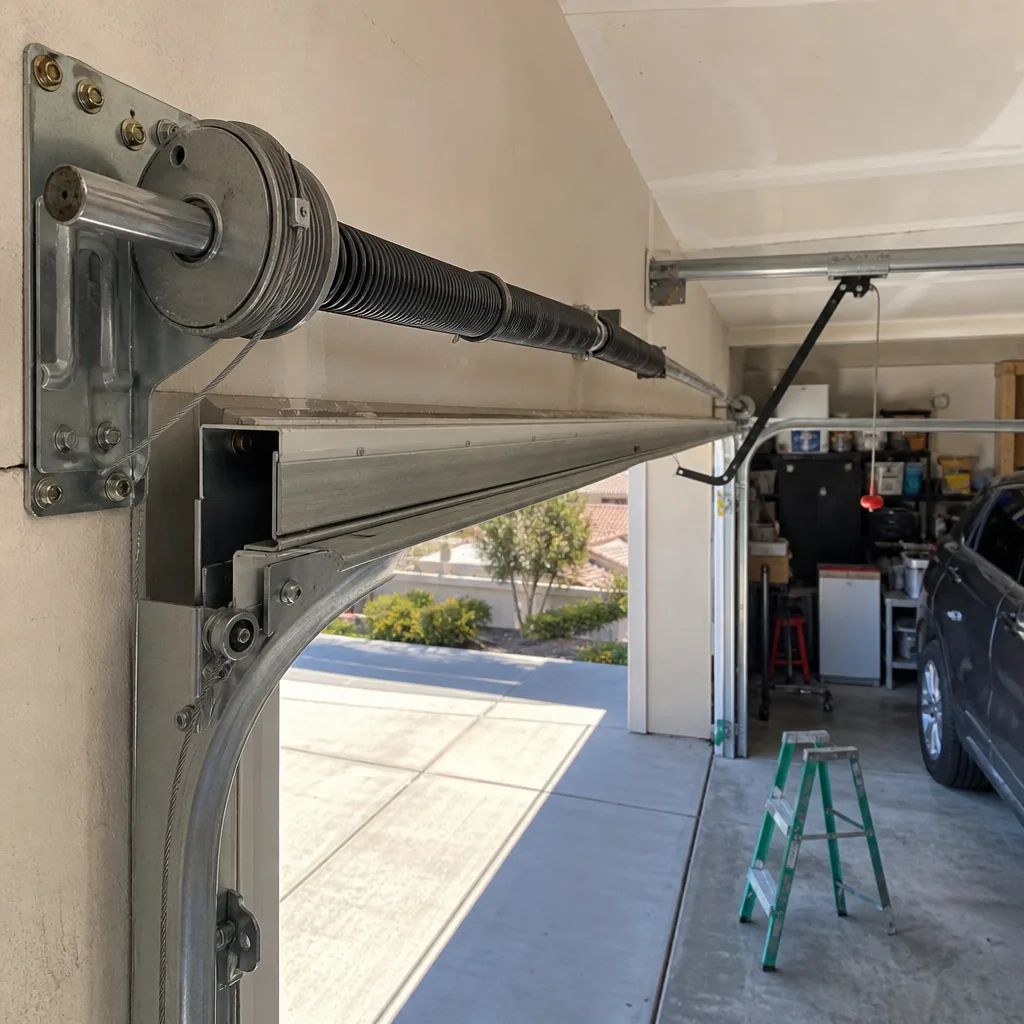
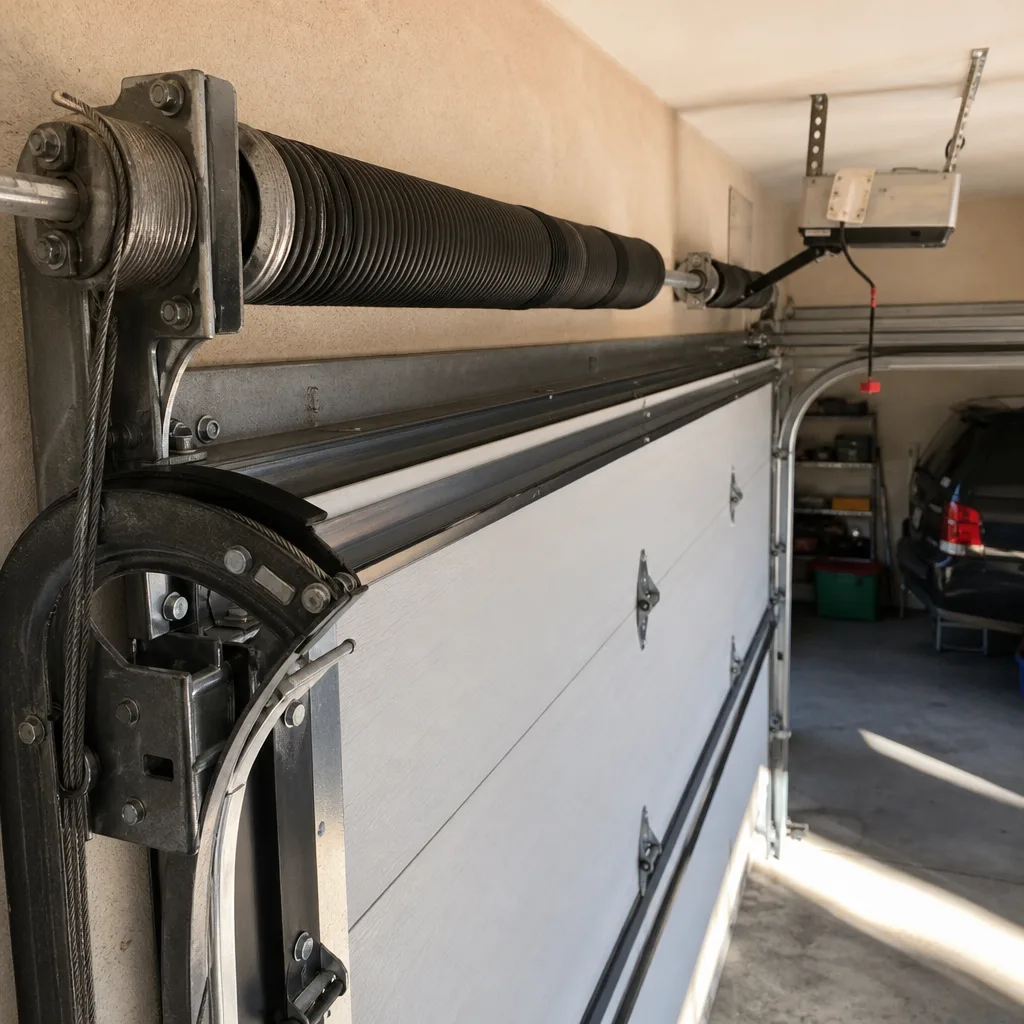
1. Torsion springs: the #1 Hemet failure
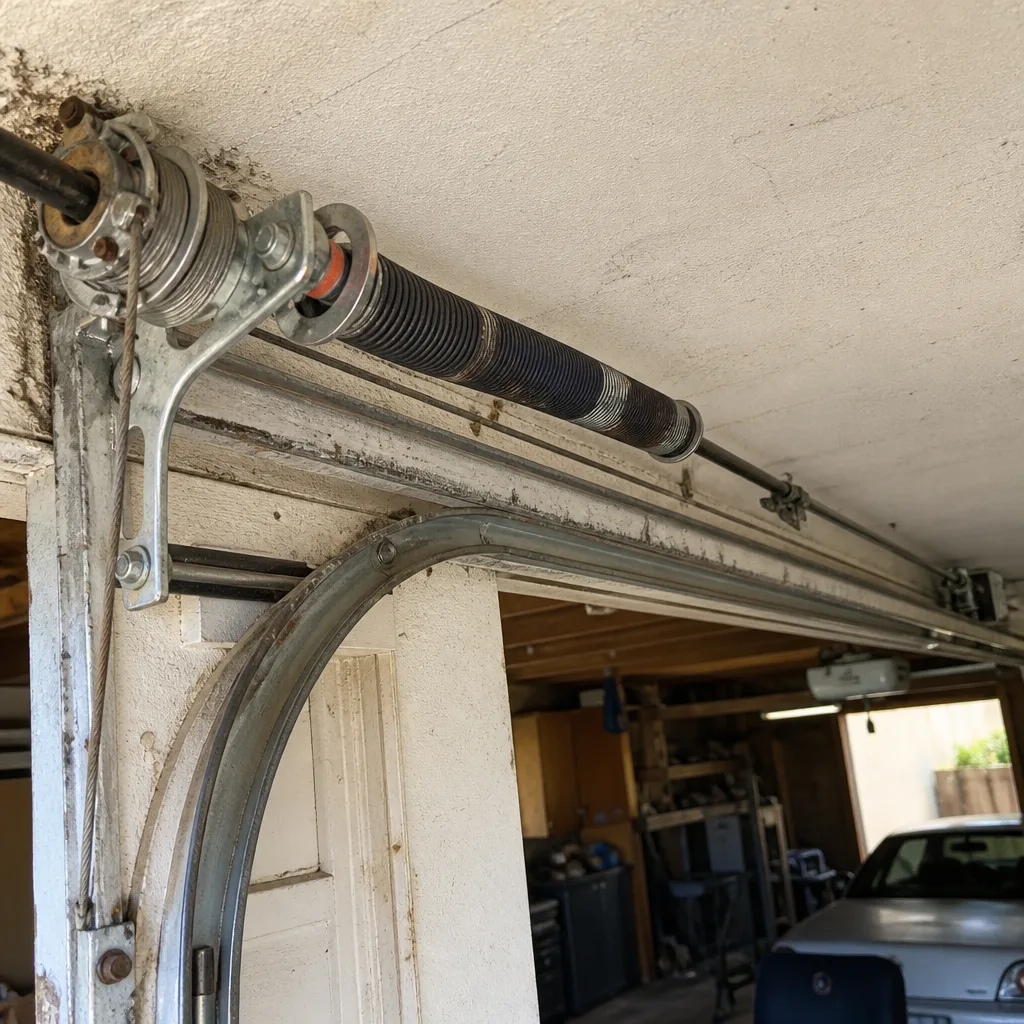
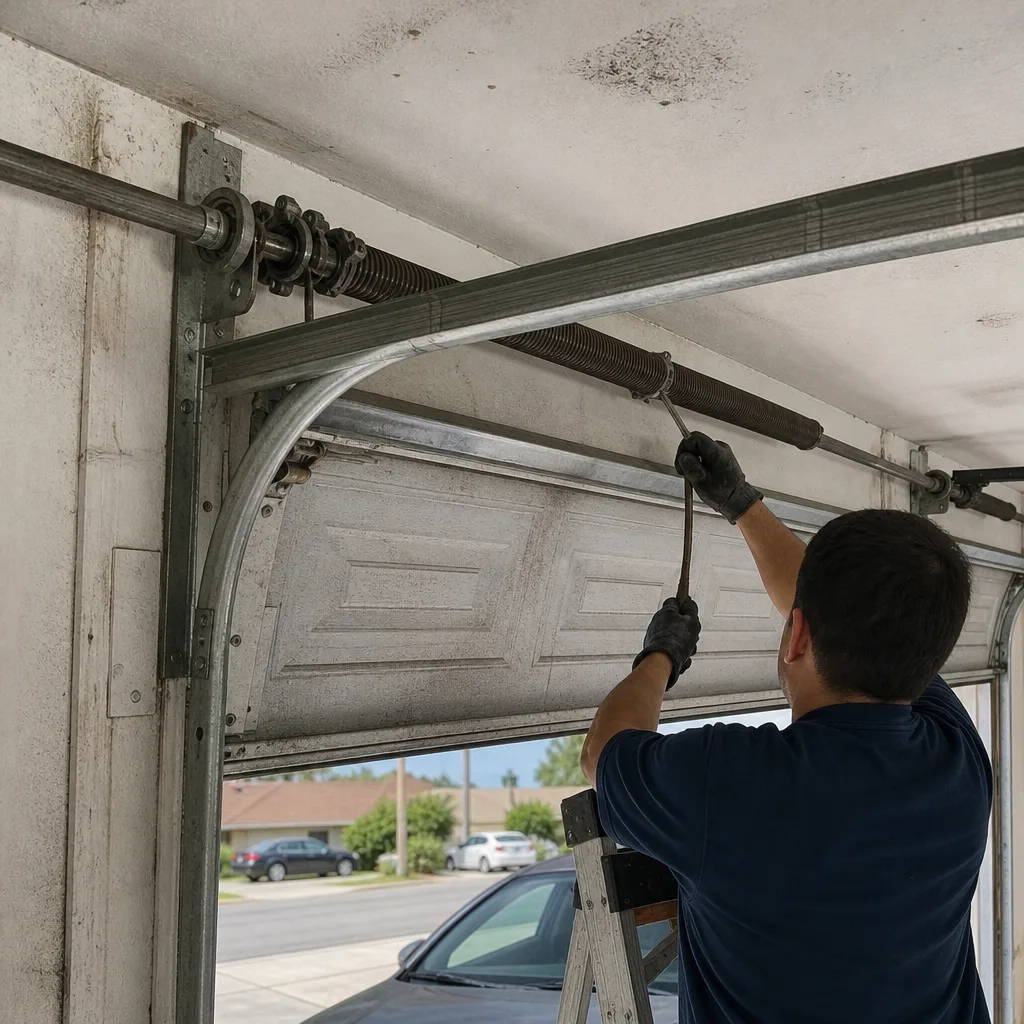
A snapped torsion spring is unmistakeable. You’ll hear a bang like a firecracker from inside the garage, and the door will feel dead-heavy if you try to lift it manually. In Hemet, spring failures cluster in September and October, after the steel has absorbed an entire summer’s worth of thermal cycling. If you have two springs, and one fails, the other is usually close behind. Replace both together. Always.
What we see: heat-cycled springs with micro-fractures at the set-screw points, especially on doors installed without proper pre-tension checks.
2. Lift cables: the casualty of spring neglect
Cables don’t usually fail on their own. They fray and snap because a worn spring puts uneven load on one side, or because a door gets yanked up one time too many with too little counterbalance. Once a cable snaps, the door goes cockeyed in the tracks, and continued operation will bend the track, crack a panel, or worse. This is not a do-it-yourself repair. Cable replacement requires releasing spring tension, and spring tension is the whole reason the door goes up smoothly.
3. Rollers: the dust problem made visible
Nylon rollers last five to seven years in Hemet’s dust before they degrade enough to matter. Metal rollers last longer but rattle louder. When a roller’s bearing fails, the wheel stops rolling and starts sliding on the track, which creates flat spots on the nylon and wear lines inside the track. The fix is affordable and fast: pull the door panels, replace the rollers, done. But if you wait, a stuck roller can bind the door mid-travel and bend a track section.
4. Tracks: the alignment casualty
Tracks don’t fail spontaneously. They get bent by doors operating with a broken spring or cable. If your door suddenly scrapes on one side, check the spring first. A track that’s visibly kinked or out-of-square is usually the result of something else going wrong underneath. In Hemet, we also see track issues after monsoon wind events push debris into the track channel, which then jams a roller.
5. Opener: the misdiagnosed patient
Openers get blamed for everything. Door won’t open? Must be the opener. Actually, in our experience, the opener is the failure point roughly one time in four. The other three times, it’s a spring, a cable, or a roller the opener can no longer move. If your opener’s motor runs but the door doesn’t move, the problem is usually mechanical, not electronic. If the opener makes no sound at all, that’s likely the logic board, a gear, or a capacitor. For opener-specific diagnostics, see our dedicated Garage Door Opener Repair in Hemet page.
What You Can DIY Safely and What You Shouldn’t Touch
Here’s the boundary line, stated plainly.
Safe DIY tasks
- Lubrication: white lithium grease on hinges, springs, and the opener rail. Use a dry silicone spray on rollers. Do this twice a year, spring and fall. This is the highest-value maintenance task in Hemet.
- Photo-eye cleaning: wipe the lenses on both safety sensors at the base of the door. Dust accumulation on photo-eyes is one of the most common false “opener failure” diagnoses we see.
- Balance test: pull the release handle and lift the door manually. It should rise smoothly and stay put around waist height. If it drops, springs are weakening. This costs you nothing and tells you a lot.
- Visual inspection: check cables for fraying, look for wobbling rollers, listen for grinding. You’re not fixing anything; you’re gathering information for a better phone estimate.
Do NOT attempt
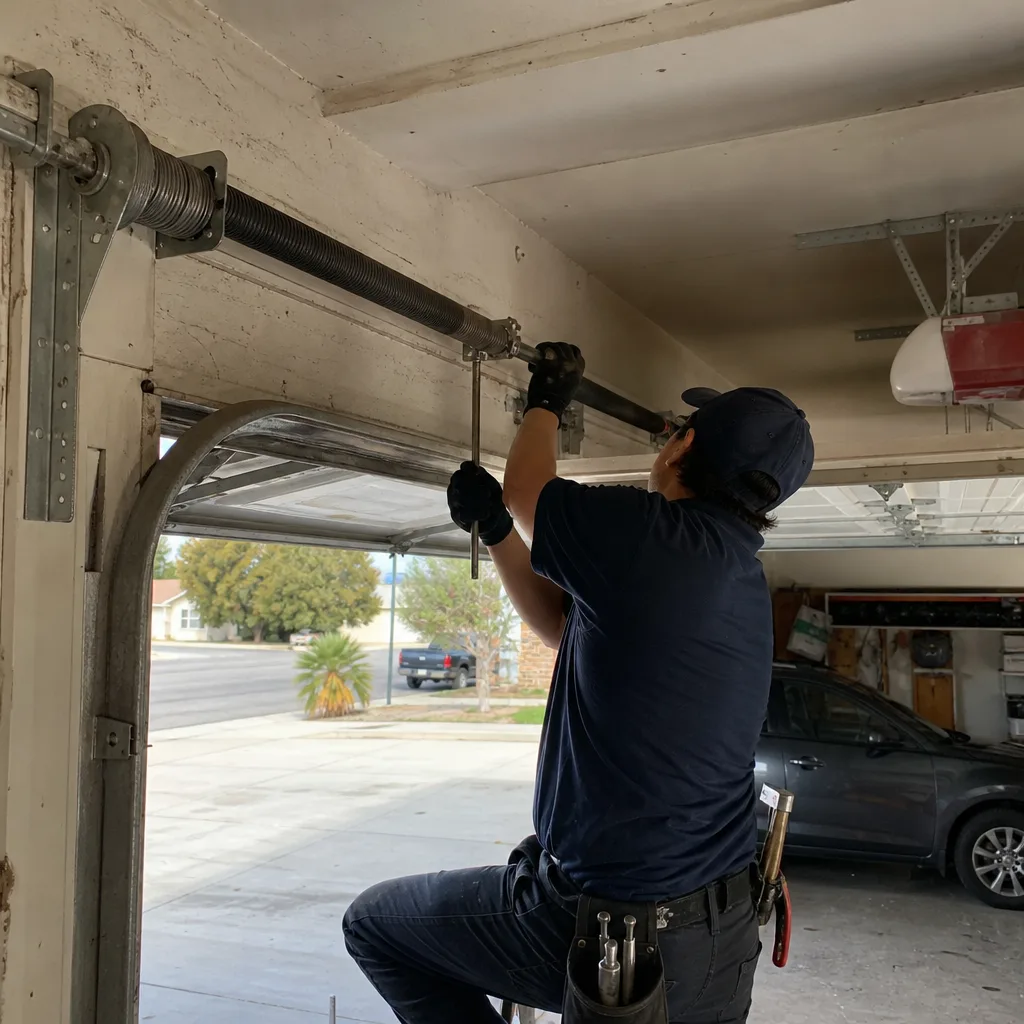
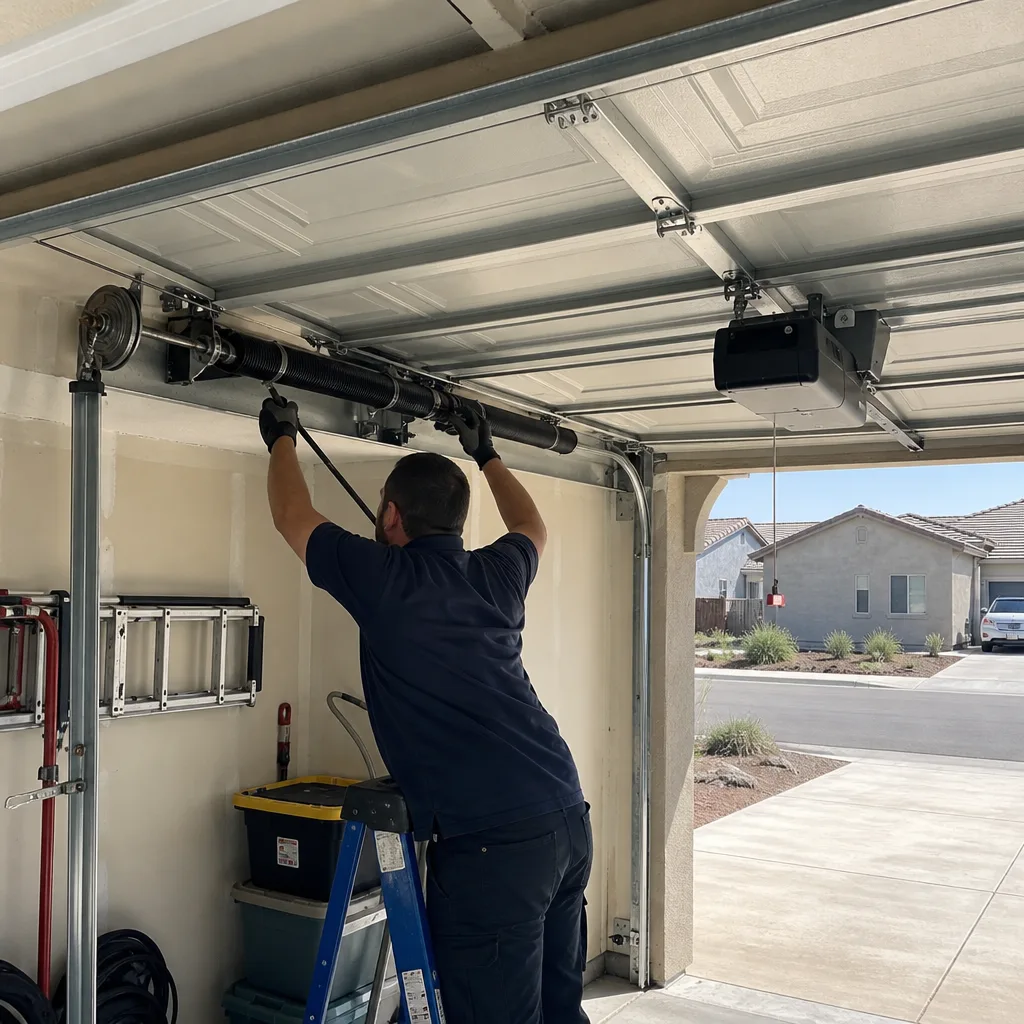
- Torsion spring replacement: a torsion spring under full tension stores hundreds of foot-pounds of energy. If a winding bar slips, the released energy will find something to hit. That something is often a hand, a face, or a ladder. Professional technicians use specific tools, clamping procedures, and release sequences. This is the one repair where “I watched a YouTube video” is the last thing you should think before making the call.
- Cable replacement: cables connect directly to the spring system. Touching a cable under tension exposes you to the same stored-energy risk as the spring itself.
- Track repair or panel realignment: doors weigh 150 to 400 pounds. When one panel comes out of the track, the whole assembly can shift unexpectedly. Pinched fingers are the best-case scenario. Crushed skin and broken bones are the common outcomes.
- Opener motor teardown: capacitor discharge is a real thing. Even unplugged, a capacitor can hold enough charge to knock you back. Leave internal opener work to someone who carries a discharge tool.
If you’re not sure which category your issue falls into, call us. The phone estimate is free, and we’ll tell you honestly whether it’s a DIY task or a service call. Our Garage Door Repair in Hemet page covers what we handle day to day.
Seasonal Maintenance Calendar for Hemet Weather
Hemet has two punishing seasons: summer heat and late-summer dust. Here’s what to do and when.
March to April: pre-heat preparation
- Lubricate all hinges, springs, and rollers. Use a lithium-based grease on metal-to-metal contact points. Wipe away excess so it doesn’t attract dust.
- Test the door balance. Pull the release and lift manually. If it doesn’t stay at waist height, call a professional before summer adds more stress.
- Check the weather stripping along the bottom and sides. Cracks let heat and dust in.
- Inspect cables for early fraying. A cable that’s 15% frayed in April is 60% frayed by August.
June to September: summer survival
- Reduce daily cycle count where possible. Every time the door cycles, springs accumulate fatigue. If you’re in and out ten times a day, consider leaving a car outside during peak heat months.
- Listen for new noises. A door that starts creaking in July and gets ignored until October is a door headed for a September spring failure.
- Keep photo-eyes clean. Dust and heat haze don’t mix well with sensors.
October to November: post-monsoon cleanup
- Clean tracks with a dry rag and compressed air. Remove the dust that monsoonal winds deposited inside the track channel.
- Re-lubricate after cleaning. The dust you just removed was sitting on whatever grease survived summer.
- Check roller condition. If nylon rollers show flat spots or cracks, replace them before cooler weather brings more door cycles.
- Do a final balance test. Spring fatigue follows peak heat by about six to eight weeks, which means failures cluster in fall. Catch the weakening spring early.
This calendar covers the majority of what a homeowner in Hemet should do without professional help. For everything else, including annual spring tension checks, call a specialist. We handle the full door system, from mechanical panels to opener drive systems, so you rarely need a second contractor. Learn more on our Garage Door Service Hemet home page.
How to Document a Repair Issue Before You Call
A good phone estimate starts with good information. Here’s how to gather it.
- Take photos of the failure point. Not one photo; five. Close-up of the spring. Wide shot of the door in its current position. Photo of any frayed cable. Photo of the track where the roller seems stuck. Photo of the opener brand label if you suspect opener issues.
- Record a short video of the door cycling. Thirty seconds of the door going up and down tells us more than a ten-minute phone description. The sound it makes is diagnostic data.
- Note the door’s behavior precisely. “Won’t open” is vague. “Opens six inches then reverses” or “goes up two feet then slams down” or “opens fine but makes a grinding noise at the midpoint” are descriptions that narrow the problem before we arrive.
- Find the manufacturer label. It’s usually on the inside of the door near the top edge. Brand and model matter for parts compatibility. If you have a Clopay, Amarr, Wayne Dalton, Craftsman, or Raynor door, write that down. It matters more than you’d think.
- Report the garage’s sun exposure. South-facing? West-facing? Insulated or not? In Hemet, this is relevant diagnostic data because heat stress patterns differ by exposure.
This documentation routine takes ten minutes and usually saves an unnecessary truck-roll charge. Call (833) 589-9121 with your photos ready, and we can give you a more accurate estimate over the phone.
What Actually Determines Repair Cost in Hemet
Repair pricing isn’t a mystery. It’s a function of four variables, and understanding them gives you a bullshit detector for any quote.
Part type and brand
A torsion spring for a standard 16-foot door runs less than a spring set for a custom-height or carriage-style door. Brand matters too. Wayne Dalton doors sometimes use proprietary spring systems that cost more than generic equivalents. Clopay and Amarr doors tend to use standard torsion assemblies, which keeps parts costs straightforward. Craftsman openers from the 2000s use different logic boards than modern Chamberlain units, and those boards aren’t getting cheaper. We service all eight major brands, so we can quote accurately whether you have a Raynor door from the 90s or a LiftMaster opener installed last year.
Spring cycle rating
All torsion springs are rated for a certain number of cycles. Basic springs last 10,000 cycles. Heavy-duty springs last 30,000. In Hemet’s heat, a basic spring may only hit 6,000 to 7,000 cycles before fatigue wins. If someone quotes you a spring replacement without asking about cycle rating, ask them why. High-cycle springs cost more upfront but last longer in this climate.
Door weight and size
A 16-foot-wide door needs stronger springs than an 8-foot one. A wooden door outweighs a steel door by a factor of three. Those differences change the spring spec, and the spring spec changes the price. Honest numbers, not surprises.
Access and condition
If your garage is packed with furnishings and we can’t safely place a ladder, that adds time. If your torsion tube and track hardware are rusted or stripped from previous work, extraction takes longer. We quote the price before work starts and we don’t change it once we’ve seen the door unless you ask us to do additional work.
Every repair we do is quoted and agreed before any work begins. No surprises on the invoice, no mystery line items. For full door replacement pricing, see our Garage Door Installation in Hemet page.
Brand-Specific Repair Notes for Common Hemet Doors
Your door’s brand determines how we approach the repair. Here’s what we’ve learned working on the equipment Hemet homeowners actually have.
Clopay and Amarr: the standard-bearers
Most residential doors in Hemet are Clopay or Amarr steel panels. These two brands use conventional torsion spring systems and standard roller sizes, which makes repairs straightforward. The weak points are the bottom weather seal, which cracks in Hemet heat, and the cable drums, which wear after a decade of dust abrasion. Parts are readily available, and most repairs are same-day compatible.
Wayne Dalton: the proprietary complication
Wayne Dalton’s TorqueMaster system uses internal springs, which confuses DIY-minded homeowners. You can’t see the spring, you can’t count coils, and attempting to “tighten” the wrong component results in a worse problem. We carry Wayne Dalton-specific parts and know how to convert a TorqueMaster door to a standard torsion system if that’s the better long-term call for your garage.
Craftsman openers: the workhorse with aging electronics
Craftsman openers installed in the 2000s are still everywhere in Hemet, especially in homes built during the housing boom. The mechanical drive train on these units was solid. The logic boards and capacitors are now reaching end-of-life. If your Craftsman opener has become intermittent, it’s probably the board, and the board may cost more than a modern entry-level opener. We’ll tell you honestly if repair or replacement makes more sense.
Raynor: the durable but off-radar brand
Raynor residential doors show up less frequently, but they’re built heavier than most competitors. The steel is thicker, the hinges are larger, and the springs are often rated for more cycles. That’s the good news. The challenge is that generic replacement parts sometimes don’t fit precisely, which is why we keep Raynor-compatible components in stock.
Brand fluency matters because a Craftsman opener diagnosis shouldn’t take the same approach as a LiftMaster logic board issue. Your brand, our expertise.
Common Mistakes to Avoid
- Ignoring the September spring failure pattern. In Hemet, springs fail in clusters after summer heat peaks. If your door feels heavy in August, don’t wait for October. A spring that’s weakening now will fail completely, and a complete failure takes the cables with it.
- “Fixing” an opener symptom without checking the springs. If the opener strains, the spring set is usually the issue, not the motor. Replacing an opener when the springs are shot is like replacing your car’s transmission when the tires are flat.
- Lubricating with WD-40. WD-40 is a penetrant and solvent, not a lubricant. It strips whatever grease remains and accelerates wear. Use white lithium grease on metal contact points and silicone spray on nylon rollers.
- Running the door with one broken spring. Two-spring doors share the load. When one spring fails, the opener is now lifting the entire door weight against the remaining spring’s resistance. That burns out the opener motor and strains the good spring into an early failure. Replace both springs at once.
- Using the emergency release while the door is up. If the door is fully raised and you pull the release, a broken spring means the door will fall. That’s a 350-pound door. If you must release the door, lower it to the ground first if safe to do so, then release.
- Calling a handyman for torsion spring work. Handymen don’t carry the right winding bars, they don’t stock multiple spring sizes, and when the job goes wrong, you’re the one calling a specialist to undo the damage. We repair handyman botch-jobs regularly. The second repair always costs more than the first would have.
- Skipping the annual balance test. A 60-second manual lift test once a month catches spring fatigue early. Most Hemet homeowners never do it once. That skipped test is the difference between a planned $200 spring replacement and an emergency $500 repair with cable damage.
When to Call a Professional
Call a professional if your door makes a sharp bang and won’t lift, if a cable is frayed or snapped, if the door sits crooked in its tracks, if a torsion spring is visibly broken, or if your opener runs but the door doesn’t move. For a full local overview, read The Complete Guide to Garage Door in Hemet. These are not diagnostic puzzles for a homeowner. They’re mechanical failures with real safety stakes. A door operating on damaged springs or cables can fall unexpectedly, and the person underneath it bears the full weight. Garage Door Service Hemet offers free estimates in Hemet. Call (833) 589-9121, describe what you’re seeing, and we’ll tell you whether it’s urgent, routine, or something you can handle yourself. If it needs a specialist, we’re already on the phone.
Frequently Asked Questions
Torsion spring replacement in Hemet typically runs between $180 and $340 for a standard two-spring setup, depending on door size, spring cycle rating, and brand compatibility. High-cycle springs cost more but last longer in Hemet’s heat. The exact price depends on your door, and we quote before starting any work. Call (833) 589-9121 for a free estimate.
Most spring, cable, and roller repairs are same-day jobs because we carry the common parts for LiftMaster, Chamberlain, Genie, Clopay, Amarr, Wayne Dalton, Craftsman, and Raynor systems. If your door has an uncommon configuration, parts may need a day. The fastest way to find out is to call (833) 589-9121 with your door’s brand and a photo of the problem.
No. We quote from photos and your description before arriving, and the price we quote is the price you pay unless you ask for additional work. If we find something unexpected during repair, we stop and call you with the new number before touching anything else. Your approval comes first.
Most of the time, yes. We stock springs in multiple sizes, cables, rollers, hinges, and opener components for the eight brands we service. That’s what allows same-day repairs in Hemet rather than two-visit diagnostics. If a specialized part isn’t on the truck, we tell you before scheduling the repair.
Steel fatigue accelerates in sustained heat. Springs that would last 10,000 cycles elsewhere may fail at 6,000 to 7,000 cycles in a Hemet garage exposed to daily 130°F summer interiors. That’s why annual spring checks and fall season awareness matter more here than in coastal climates.
That’s a spring issue, not an opener issue. The springs are supposed to counterbalance the door weight. When they weaken, the opener works harder, and eventually both fail. Test your door’s balance monthly by releasing the opener and lifting manually. If it doesn’t stay at waist height, call for a spring inspection before summer heat takes advantage of the weakness.
The Bottom Line
Hemet garage doors fail predictably. Heat stresses springs. Dust grinds rollers. Neglected lubrication turns minor friction into major wear. None of this is mysterious, and most of it is preventable. The monthly balance test, a twice-yearly lubrication routine, and the discipline to document problems before calling a technician will save you real money over the life of your door. When something does fail, the sequence matters: springs first, cables second, rollers third, tracks fourth, opener last. Skip the sequence and you’ll replace the wrong part. Follow it and you’ll know exactly what to tell the person on the phone. We’re that person when you need us. One call, one specialist. For more guides & resources, explore our blog.
Written by the team at Garage Door Service Hemet, serving Hemet since 2018.
See the difference
 Before
 After
 Before
 After
 Before
 After